
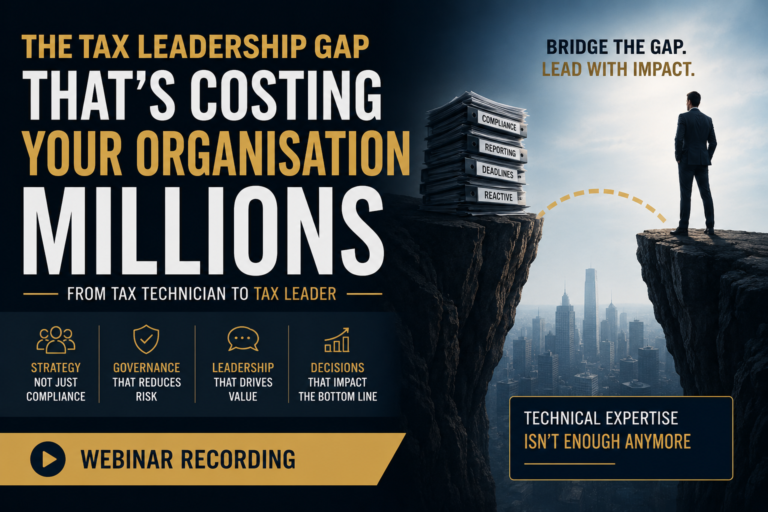
From Tax Technician to Tax Leader: Why Modern Tax Functions Need Leadership Capability
Table of Contents
Most tax teams are technically strong. Many are staffed by professionals who understand legislation, treaties, transfer pricing, compliance obligations, reporting deadlines and tax risk.
But technical strength alone does not always create an effective tax function.
In many organisations, tax professionals are promoted because of their technical expertise. They are then expected to lead teams, advise boards, manage revenue authority audits, work with finance and legal departments, oversee data requirements, engage external advisers, and guide the organisation through complex tax decisions.
That is where the leadership gap begins.
The modern tax function is no longer only a compliance support function. It now operates in an environment shaped by BEPS, Pillar Two, more assertive revenue authorities, digital tax administration, increased board scrutiny, reputational pressure and cross-border risk. Tax professionals are therefore expected to do more than answer technical questions. They must help the organisation make better decisions.
This was the central theme of the Academy of Tax Law webinar, From Tax Technician to Tax Leader: The Leadership Gap That’s Costing Organisations Millions, presented by Dr Daniel N. Erasmus.
The message is clear: the tax leader does not simply answer the tax question. The tax leader builds the system through which better tax decisions are made.
Why the tax leadership gap matters now
Tax practice has changed.
Revenue authorities are increasingly data-driven. Tax audits are more targeted. Transfer pricing enforcement has expanded. Digital reporting and e-invoicing are changing how tax data is collected, analysed and challenged. Boards and audit committees are paying closer attention to tax governance, reputational risk and the organisation’s overall approach to tax compliance.
At the same time, tax teams are often under pressure to do more with limited resources. They must manage compliance deadlines, respond to audits, advise on transactions, monitor legislative change, oversee documentation, support financial reporting and work across multiple business units.
In this environment, the old model of tax as a technical back-office function is no longer sufficient.
A technically competent tax function may still struggle if it lacks:
- clear governance structures
- documented accountability
- audit response protocols
- effective board reporting
- tax data ownership
- cross-functional integration
- leadership capability within the team
The cost of this gap is not always visible immediately. It often becomes visible only when something goes wrong: a revenue authority audit, a major transaction, a board question, a system implementation, or a dispute that could have been avoided with better preparation.
The difference between a tax technician and a tax leader
The tax technician plays an essential role. Technical excellence remains the foundation of serious tax practice. Organisations still need professionals who can interpret legislation, understand case law, apply treaty principles, manage compliance and identify risk.
But leadership requires a wider frame.
A tax technician asks:
- What does the law say?
- What is the correct tax treatment?
- What documentation is required?
- What are the filing deadlines?
- What is the technical risk?
A tax leader asks additional questions:
- How does this tax issue affect the business?
- Who needs to be involved before a decision is made?
- What is the organisation’s risk appetite?
- How will this be explained to the audit committee or board?
- What evidence will be needed if the position is challenged?
- Is the tax team structured to manage this risk consistently?
- Are the systems producing the right data?
- Is tax involved early enough in commercial decision-making?
This is the practical distinction.
The technician answers the tax question.
The leader ensures the organisation can make, document, defend and govern the tax decision.
That difference matters.
A technically correct answer may still fail if the documentation is missing, the business facts do not align with the formal position, the board does not understand the exposure, the finance system cannot produce the required data, or the tax team is brought into the decision too late.
Tax leadership is therefore not a substitute for technical expertise. It is the discipline that connects technical expertise to organisational decision-making.
Three moments that expose weak tax leadership
The leadership gap is often hidden during routine compliance. Returns are filed, deadlines are met and technical questions are answered.
But pressure reveals the strength of the tax function.
In the webinar, Dr Erasmus identified three moments where weak tax leadership becomes visible: revenue authority audits, board reporting and digital transformation projects.
1. Revenue authority audits
An audit does not usually create the weakness. It exposes it.
When a revenue authority begins an audit, the organisation quickly discovers whether its tax function is prepared. The issues are often practical rather than purely technical.
Common weaknesses include:
- missing or incomplete documentation
- outdated intercompany agreements
- finance data that does not reconcile
- business conduct that differs from formal reports
- unclear responsibility for audit responses
- external advisers appointed too late
- local teams and headquarters not aligned
- lack of an audit-ready defence file
These problems place the tax team under immediate pressure. Deadlines are imposed. Information must be collected. Internal stakeholders must be coordinated. External advisers must be briefed. The organisation must decide how to respond, what to disclose, what to explain and how to defend its position.
If there is no central audit response protocol, the process can become fragmented very quickly.
This is where leadership matters.
A well-led tax function prepares before the audit begins. It knows where documents are stored. It understands which transactions carry risk. It has identified the responsible internal owners. It has a process for involving legal, finance, operations and external advisers. It maintains defensible records and understands how to manage revenue authority engagement.
Audit readiness is not only a technical exercise. It is a leadership discipline.
2. Board and audit committee reporting
The board is rarely asking for a technical lecture.
When a board or audit committee asks about tax risk, the underlying question is usually practical:
What decision do we need to make?
The tax leader must therefore translate technical analysis into business judgement.
That means explaining:
- the nature of the exposure
- the likelihood of challenge
- the possible financial impact
- the available options
- the recommended course of action
- the timeline for decision-making
- the governance implications
This does not mean oversimplifying the law. It means communicating the tax issue in a form that allows the board to exercise judgement.
A common weakness in tax reporting is the tendency to answer board-level questions with technical detail that does not lead to a decision. The board does not need every legislative reference. It needs to understand the risk, the evidence, the financial consequences, the available choices and the recommended response.
Tax leaders must therefore be able to move between technical depth and executive communication.
That ability is not automatic. It must be developed.
3. Digital transformation projects
Digital transformation is one of the most important areas where tax leadership is now required.
Many organisations are implementing new finance systems, enterprise resource planning systems, data tools, reporting platforms and automation processes. These projects often begin as finance, technology or operations initiatives. Tax may be consulted late, or only after the system has been designed.
That creates risk.
If tax is not involved in system design, the organisation may automate its weaknesses.
Common issues include:
- missing tax data fields
- poorly mapped tax codes
- intercompany flows that are not visible
- VAT or GST reporting gaps
- transfer pricing data that remains manual
- Pillar Two data requirements overlooked
- reports that cannot support audit or compliance needs
A tax leader does not need to own the system. But tax must own the tax requirements.
That means tax must be involved early enough to identify what data is needed, how transactions must be classified, what documentation must be retained, how reporting will work and what evidence may be required in the event of an audit.
Digital transformation is not only a technology issue. It is a tax governance issue.
Why audit readiness is a leadership discipline
Many organisations treat audit response as an event. A letter arrives from the revenue authority, and the tax team begins to assemble the documents, explanations and advisers required to respond.
That is reactive tax management.
Audit-ready organisations work differently. They build the capability before the audit begins.
Audit readiness requires:
- clear ownership of tax positions
- proper documentation retention
- reconciled finance and tax data
- current intercompany agreements
- evidence files for material transactions
- documented decision-making processes
- defined escalation routes
- coordinated adviser management
- clear communication with the board or audit committee
This requires leadership because it cuts across the organisation. Tax cannot build audit readiness in isolation. It needs cooperation from finance, legal, operations, commercial teams, IT and external advisers.
It also requires judgement. Not every issue carries the same level of risk. Tax leaders must know which positions require deeper documentation, which matters need escalation, which risks should be reported, and which issues require external support.
Audit readiness is therefore not simply about keeping documents. It is about building the organisational discipline to defend tax positions when they are challenged.
The role of the tax steering committee in tax governance
One of the strongest governance tools discussed in the webinar is the tax steering committee.
A properly designed tax steering committee gives the organisation a structured way to identify, manage, document and escalate tax risk. It also creates a forum where tax is connected to wider business decision-making.
The tax steering committee can assist with:
- monitoring material tax risks
- reviewing significant transactions
- coordinating audit readiness
- tracking open tax issues
- ensuring accountability across departments
- escalating matters to the audit committee or board
- aligning tax positions with business conduct
- improving communication between tax, finance, legal and operations
This structure is particularly important because many tax risks do not arise from the law alone. They arise from weak processes, poor documentation, late involvement, unclear responsibility or inconsistent implementation.
The tax steering committee helps move the organisation from informal tax management to disciplined tax governance.
It also reinforces the idea that tax is not merely a technical function. It is part of enterprise risk, governance and strategic decision-making.
How tax leaders translate technical risk into business decisions
One of the most important skills of the tax leader is translation.
The tax leader must understand the law, but must also explain what the law means for the business.
That includes translating:
- technical risk into commercial exposure
- audit findings into decision options
- documentation weaknesses into governance action
- tax disputes into financial and reputational risk
- system limitations into data requirements
- compliance obligations into operating processes
This skill is especially important when engaging with senior executives, boards and audit committees.
A tax leader must be able to say:
- here is the issue
- here is why it matters
- here is the level of risk
- here is the evidence we have
- here is the evidence we still need
- here are the options
- here is the recommended decision
- here is what must happen next
That is leadership communication.
It gives decision-makers a clear view of the issue without losing the legal and technical substance beneath it.
Developing tax leadership capability through structured education
Tax leadership is often learned informally. Many professionals develop it through experience, pressure, audits, disputes and exposure to senior decision-making.
Experience matters. But it is not always enough.
The challenge is that many tax professionals are promoted into leadership roles without formal preparation for the leadership aspects of the role. They may be technically excellent, but not yet trained to build operating models, lead teams, manage governance structures, communicate with boards, oversee audit readiness or integrate tax into business strategy.
This is why structured education in tax leadership is becoming more important.
A serious tax leadership programme should help professionals develop:
- strategic judgement
- governance awareness
- audit readiness discipline
- board communication skills
- team leadership capability
- tax risk management frameworks
- cross-functional operating models
- revenue authority engagement skills
- documentation and evidence management practices
These are the capabilities that allow tax professionals to move from technical support to leadership influence.
Moving from reactive support to strategic tax leadership
The shift from tax technician to tax leader is not about abandoning technical work. It is about placing technical work inside a stronger leadership framework.
The modern tax function must move:
- from late involvement to early visibility
- from technical explanation to business decision-making
- from informal processes to governance
- from individual knowledge to team capability
- from audit response to audit readiness
- from data frustration to data ownership
- from compliance support to strategic influence
This shift is not cosmetic. It affects how organisations manage tax risk, how they respond to revenue authorities, how they communicate with boards and how they make commercial decisions.
Tax leadership is now a necessary professional capability.
Watch the webinar and download the supporting eBook
The full webinar recording, From Tax Technician to Tax Leader: The Leadership Gap That’s Costing Organisations Millions, is avaialbe at the top of this article or at: https://www.youtube.com/watch?v=mOTCnOgjABw
You can also download the free supporting eBook:
Driving Tax Compliance: The Essential Role of the Tax Steering Committee
The eBook explores how a properly structured tax steering committee can support governance, improve compliance, clarify accountability and strengthen audit readiness.
Enter your email to download the book:
Study tax leadership with the Academy of Tax Law
The themes discussed in this article are developed in greater depth in The Mechanics of Effectively Leading Tax Teams.
This 16-week online programme is designed for tax managers, senior advisers, emerging heads of tax, CFOs, in-house advisers, consultants and professionals moving into tax leadership roles.
The programme examines how to lead high-performing tax teams, manage tax risk, build governance structures, engage with revenue authorities, communicate with the board and integrate tax into wider business decision-making.
Learn more about the programme:
https://academyoftaxlaw.com/the-mechanics-of-effectively-leading-tax-teams/