About the book
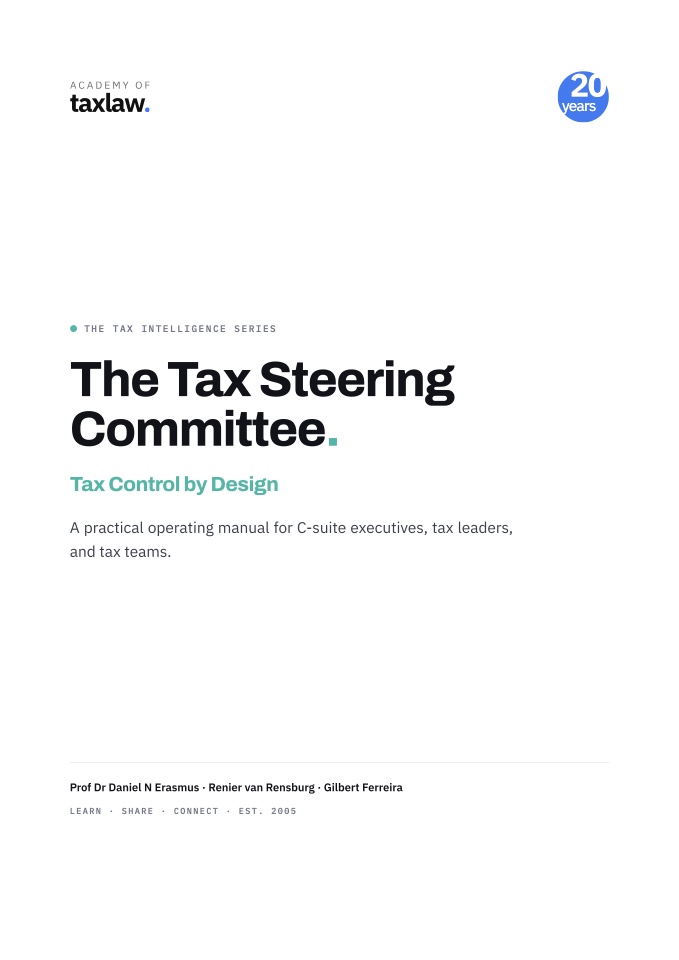
Tax compliance is not tax control. An organisation can file on time, pay what it believes is due, and still be exposed to major disputes, penalties, and reputational damage. Control is an operating capability — a system that identifies material tax risks early, evaluates them consistently, and can demonstrate every decision on the basis of evidence. The Tax Steering Committee (TSC) is the structure that delivers that capability, and this manual is the operating guide for building one.
The book starts with design: a chair model engineered for governance under scrutiny — an external tax litigator as chair, supported by an executive sponsor, typically the CFO — together with the charter, decision rights, and escalation rules, and the legal privilege, confidentiality, and evidence discipline that keep sensitive work protected. It then builds the committee step by step, even where there is no controversy: the first 30 to 90 days, membership and RACI roles, meeting cadence and agenda design, the minimum reporting catalogue, and recordkeeping that survives staff change.
When a dispute arrives, the TSC changes operating mode rather than improvising: four controversy levels with clear triggers, a controversy playbook, and disciplined reporting from routine enquiry through to litigation. For multinationals, a country-to-centre operating model standardises what is reported, when it is reported, and how decisions and positions are preserved across jurisdictions — supported by the right technology and operational infrastructure.
Implementation playbooks by organisation size, industry scenarios, and case studies make the model executable, while the final scrutiny layer confronts why TSCs drift into ceremony — weak mandates, optional actions, undefined escalation — and sets out board-ready reporting, a maturity model, and KPIs. Nine appendices of working templates, from the charter and RACI matrices to the privilege protocol, standing agendas, registers, and country packs, turn the manual into a toolkit you can run.
“Tax control is different. It is not a set of outputs. It is an operating capability.”Prof Dr Daniel N Erasmus · Renier van Rensburg · Gilbert Ferreira
What you’ll learn
- Why tax compliance is not tax control — and why a compliant organisation can still be exposed
- How to design mandate, authority, and legal privilege into the operating model, with an external-litigator chair backed by a CFO sponsor
- A step-by-step build: the first 30 to 90 days, RACI membership, meeting cadence, the minimum reporting catalogue, and recordkeeping that survives staff change
- Controversy mode: four escalation levels, a controversy playbook, and evidence discipline from enquiry to litigation
- The multinational country-to-centre model — country packs, standardised reporting, and technology infrastructure
- How to stop a TSC becoming ceremonial: failure modes, board-ready reporting, a maturity model and KPIs — plus nine appendices of ready-to-use templates
Inside the book
- Why tax compliance is not tax control
- What a Tax Steering Committee is, and what it is not
- The intention and outcomes of the Tax Steering Committee
- Where the Tax Steering Committee sits in corporate governance
- The chair model and why it matters
- The TSC charter, decision rights, and escalation rules
- Legal privilege, confidentiality, and evidence discipline
- How to start, the first 30 to 90 days
- Membership, roles, and responsibilities, with a RACI model
- Meetings, cadence, and agenda design
- What feeds into the TSC, the minimum reporting catalogue
- Recordkeeping, institutional memory, and survivability through staff change
- Controversy levels and operating modes
- The controversy playbook
- Reporting during controversy
- Central TSC and country tax governance
- Technology and operational infrastructure
- Implementation playbooks by organisation size
- Industry and operating model scenarios
- Case studies, practical templates applied
- Common failure modes, why TSCs become ceremonial
- Relationship with internal audit and enterprise risk
- Board ready reporting, what Audit Committees should expect
- Measuring effectiveness, maturity model, and KPIs